PUBLICATIONS
Higgs-Pair Production via Gluon Fusion: Top-Yukawa- and light-quark-induced electroweak Corrections
Electroweak corrections to Higgs-Pair Production via Gluon Fusion
Abstract
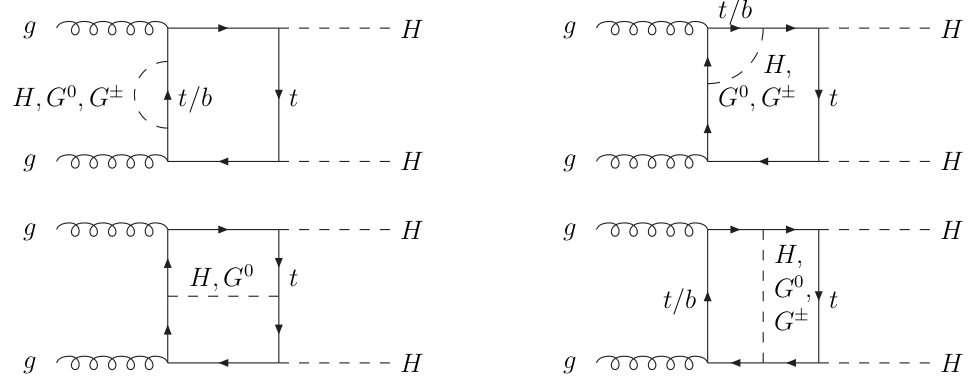
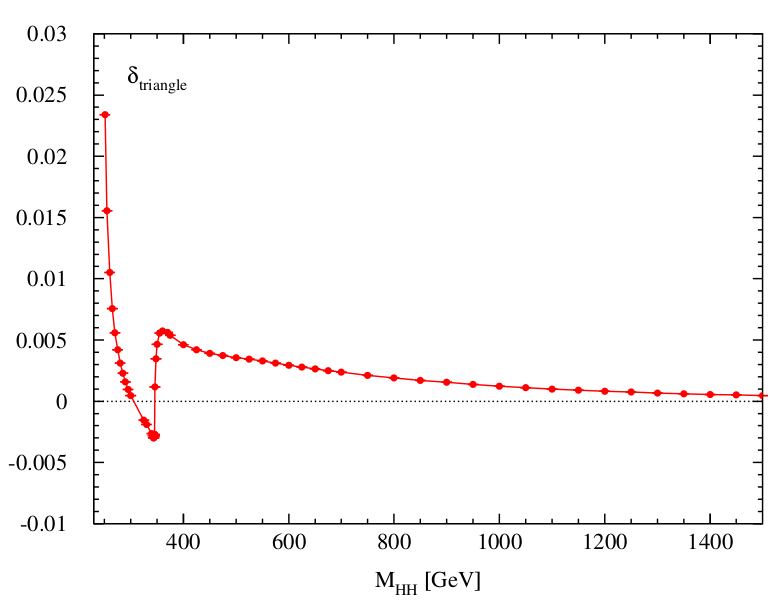
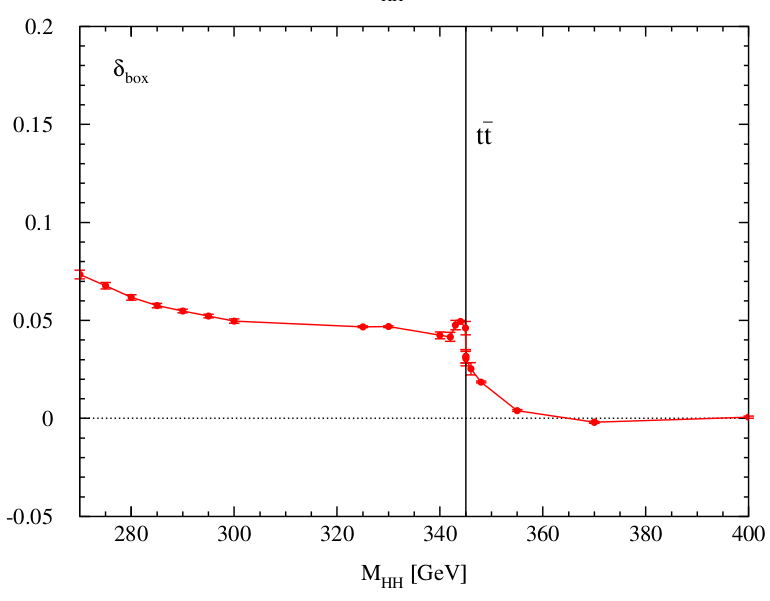
Gluon fusion is the dominant channel in Higgs-pair production process at the Large Hadron Collider (LHC) and provides the first direct access to the trilinear Higgs self-interaction. The process is loop-induced, with the main contribution emerging from top-quark loops within the Standard Model. In the past, the QCD corrections have been calculated and found to increase the cross section significantly. With the anticipated accuracies achievable at the high-luminosity LHC (HL--LHC), the theoretical uncertainties will be of increased relevance to compete with the experimental precision at the level of less than 30%. In this work, we take the next steps towards the determination of the complete electroweak corrections at next-to-leading order by calculating the full top-Yukawa and light-quark induced corrections. These corrections modify the cross section moderately in the kinematical regimes of interest.
VH Production: Threshold Resummation
Next to Soft Threshold Resummation for VH Production
Abstract
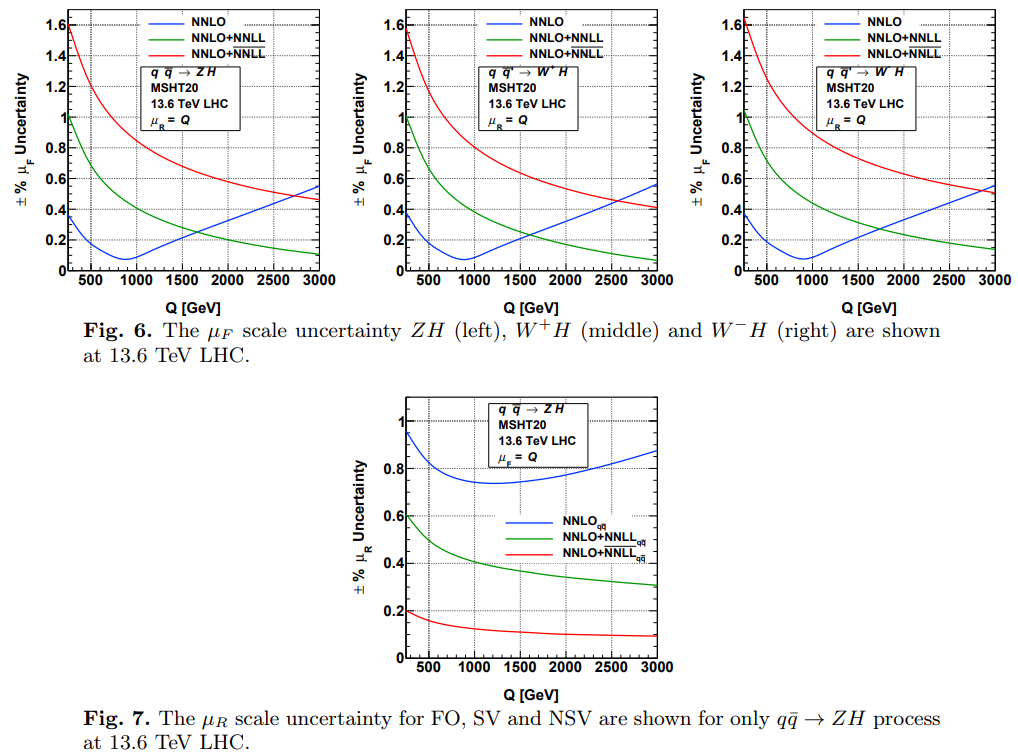
We study how Higgs bosons are produced together with heavy force-carrying particles — the W and Z bosons — at the Large Hadron Collider (LHC). This scattering process, known as associated Higgs production, provides one of the most direct ways to measure how strongly the Higgs interacts with other particles in the Standard Model. Using advanced mathematical techniques that capture the effects of very high-energy particle collisions with exceptional precision, we calculated the production rates and energy distributions of these events. Our results combine state-of-the-art theoretical predictions with the latest experimental energies at the LHC. By improving the accuracy of these predictions, our study helps researchers test whether the Higgs boson behaves exactly as the Standard Model predicts, or whether subtle deviations could reveal signs of new physics beyond what we currently know.
Next-to-Soft Pseudoscalar Higgs Production
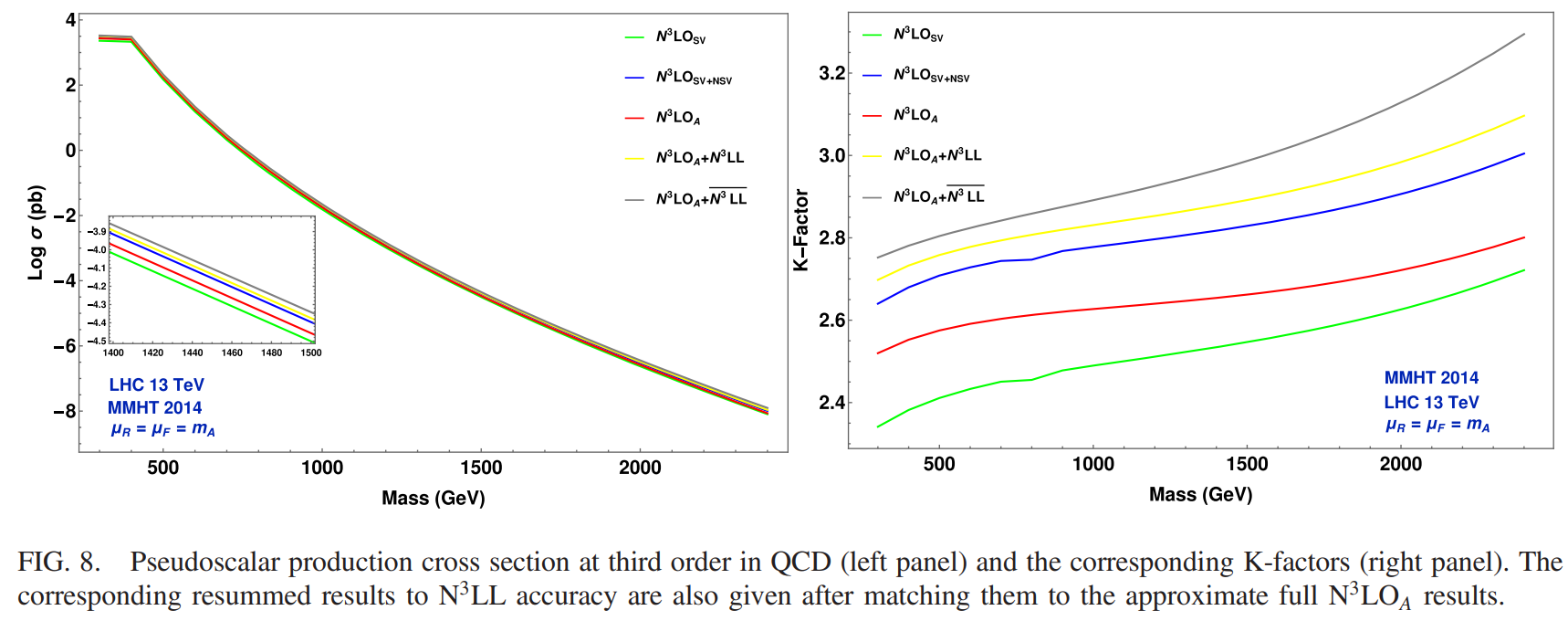
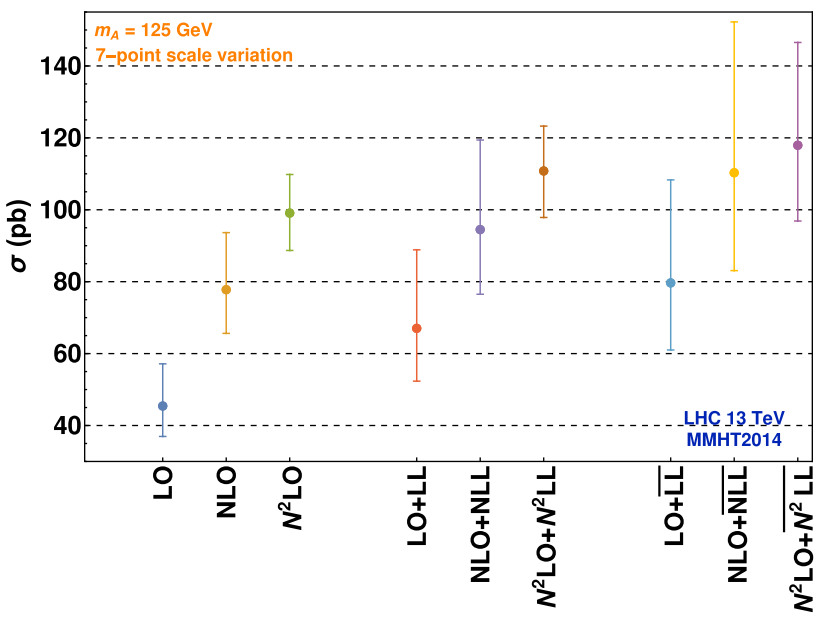
Next-to-soft-virtual resummed prediction for pseudoscalar Higgs boson production at NNLO + NNLL
Abstract
We explore one of the most precise calculations yet of how a special type of Higgs-like particle — the pseudoscalar Higgs boson — can be created when two gluons collide at the Large Hadron Collider (LHC). Our work introduces the first results that account for previously neglected "next-to-soft" effects, subtle quantum corrections that become important when particles are produced near their energy thresholds. By combining state-of-the-art resummation techniques with existing higher-order calculations, we obtained stable and accurate predictions for the production rate of these particles. We also showed that these effects significantly reduce theoretical uncertainties, making our predictions more reliable. Finally, we investigated how these quantum effects influence mixed scalar–pseudoscalar Higgs states, offering insights into how the Higgs sector might behave if physics beyond the Standard Model exists.
Two-Loop Di-pseudo Scalar Production
Two-Loop QCD Amplitudes for Di-pseudo Scalar Production in Gluon Fusion
Abstract
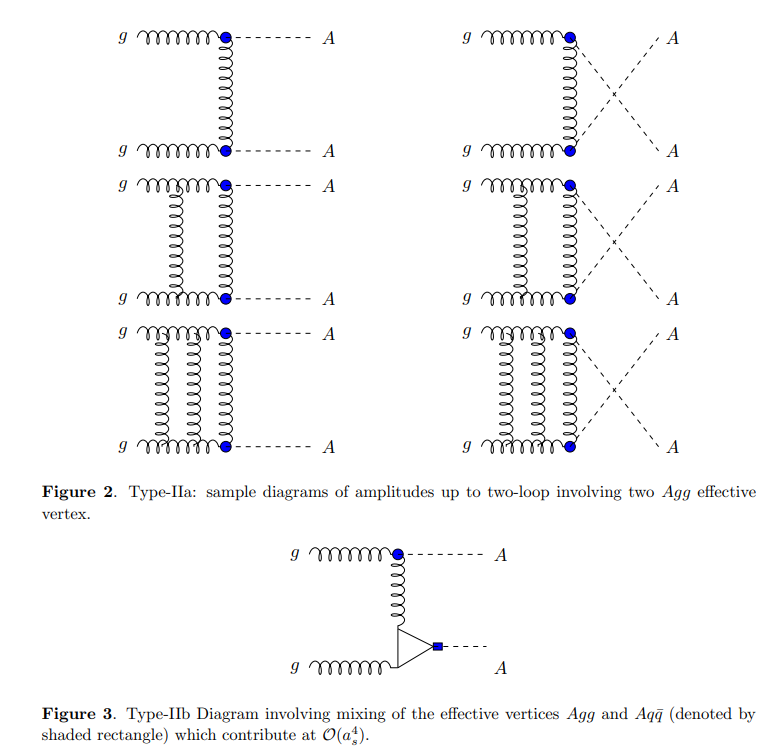
This study explores how two Higgs-like particles known as pseudoscalars can be produced together when two gluons (the carriers of the strong nuclear force) collide at very high energies. We calculated subtle quantum corrections to this process, which are essential for making precise predictions in particle physics experiments such as those at the Large Hadron Collider (LHC). Because these pseudoscalars behave differently from the Standard Model CP-even Higgs boson under the laws of symmetry (they are CP-odd), the calculations require special mathematical care to ensure that all symmetry properties are respected. Our results provide the foundation for improving theoretical accuracy in future LHC studies that search for rare or unconventional Higgs-like signals, helping to test whether nature follows the Standard Model or hints at new physics beyond it.
Pseudoscalar Higgs Production in QCD
Radiative corrections and threshold resummed predictions to pseudoscalar Higgs boson production in QCD
Abstract
My PhD research focuses on improving the theoretical precision of Higgs-sector processes at the Large Hadron Collider. The thesis presents the first next-to-soft resummed predictions for pseudoscalar Higgs production in gluon fusion, matched to next-to-next-to-leading order (NNLO) accuracy in QCD. By combining advanced resummation and effective field theory techniques, it significantly reduces theoretical uncertainties and enhances our ability to probe new-physics effects in the Higgs sector.
Di-pseudo Scalar Production in Gluon Fusion
Two-Loop QCD Amplitudes for Di-pseudo Scalar Production in Gluon Fusion.
Abstract
This work presents the two-loop quantum corrections for the production of pseudoscalar Higgs boson pairs in gluon fusion. The computation, performed using an effective field theory framework, establishes the infrared-finite and ultraviolet-consistent structure of these amplitudes. These results form the foundation for next-to-next-to-leading order (NNLO) predictions in pseudoscalar Higgs pair production and were presented as part of a conference proceeding following the JHEP publication.